There’s something about a stretch of good weather that makes you look at your garden a little differently.
What was easy to ignore through winter suddenly feels… noticeable. The overgrown corners. The tired patio. The pile of “I’ll deal with that later” quietly building up near the fence.
And the truth is, most garden clear-ups don’t start with a big plan. They start with a small decision.
“I’ll just tidy this bit.”
A few hours later, you’re halfway through a full garden reset.
This guide isn’t about turning your garden into a showroom. It’s about making it feel fresh again — with simple steps, a bit of momentum, and a realistic approach to clearing the space properly.
Start with a Walk, Not a Plan
Before you pick up a tool, take a slow walk around your garden.
No pressure. No checklist. Just look.
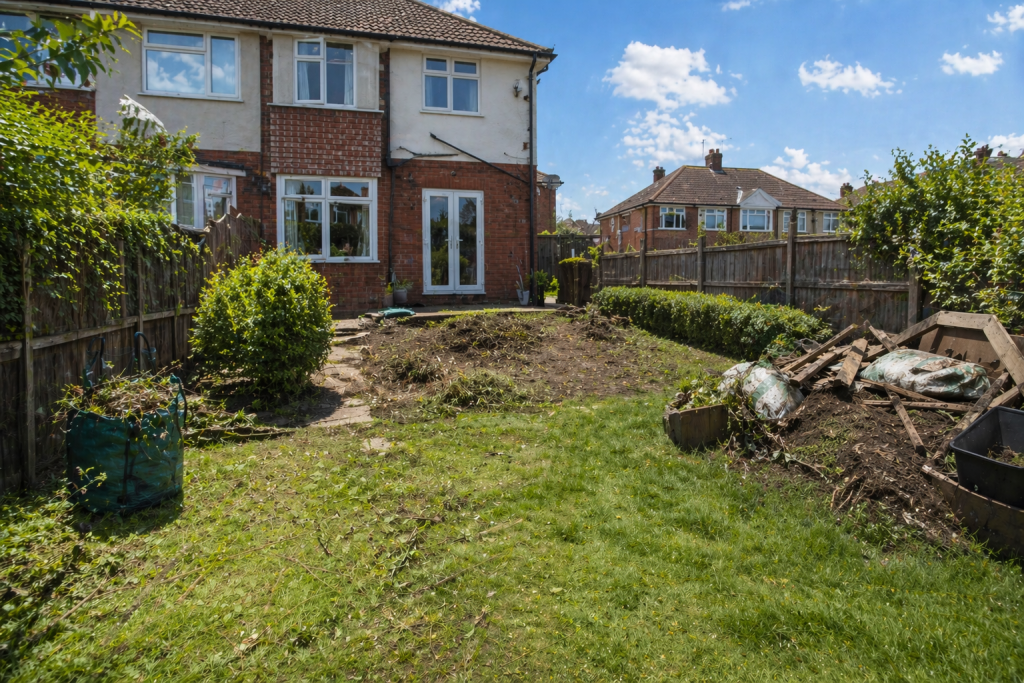
You’ll start to notice patterns. Areas that have been ignored. Things that don’t belong anymore. Materials that have built up over time — broken pots, old wood, bags of soil that have seen better days.
This first step matters more than people realise. Because once you see the space clearly, the work becomes obvious.
You don’t need to overhaul everything. You just need to decide where to start.
The First Hour: Clear Space, Don’t Perfect It
The biggest mistake people make with garden clear-ups is trying to do everything at once.
Instead, focus on clearing space.
Pull out what’s broken. Stack what can be reused. Move anything that’s just “in the way”. You’re not aiming for perfection — you’re creating breathing room.
This is where momentum builds.
Once space opens up, the garden starts to feel manageable again. And that’s usually the point where people realise just how much waste has quietly accumulated.
Old fencing panels. Worn decking. Dead plants. Soil bags. Random materials from past projects.
It adds up quickly.
When Garden Waste Becomes More Than a Few Bags
At some point, most garden clear-ups hit the same wall.
Black bags aren’t enough anymore.
Trips to the tip start to feel like a full-time job. The car gets dirty. Time disappears. And what started as a simple tidy-up begins to drag on longer than it should.
This is where having the right waste solution changes everything.
A skip, placed nearby, turns a stop-start job into a smooth one. You clear as you go. No second guessing. No “where do I put this for now”.
For larger clear-ups — especially where wood, soil, or bulky items are involved — it’s often the difference between finishing the job in a day or stretching it across weeks.
For tighter access or smaller jobs, a man with a van collection can work just as well. The key is removing friction, not adding to it.
What Can and Can’t Go in a Garden Skip
Once the skip arrives, there’s usually a moment of hesitation.
“Can this go in?”
It’s a good question — and one worth getting right early, rather than halfway through loading.
Most everyday garden waste is perfectly fine to dispose of in a skip. Things like cut branches, grass, weeds, old fencing, broken decking, soil, and general outdoor debris are all typical. Even heavier materials like slabs, bricks, and rubble from garden projects are usually acceptable.
But not everything belongs in a general skip.
Items like paint, chemicals, asbestos, gas cylinders, and tyres require specialist handling. The same applies to electrical items and anything containing batteries — including outdoor lights or tools that might not immediately look like they need separating.
That’s where people often get caught out. Not with obvious items, but with the ones that don’t look like a problem.
If you’re unsure, it’s always better to check before loading. It keeps things simple and avoids delays later.
A good rule to follow is this: if it’s natural garden waste or standard construction material, it’s usually fine. If it’s hazardous, electrical, or pressurised, it probably isn’t. Check our Skip Hire FAQ’s for more details
Invasive Plants You Should Not Put in a Skip (UK)
When clearing a garden, it is easy to assume that all plant waste can be treated the same.
In reality, that is not always the case.
Certain plants in the UK are classed as invasive non-native species, meaning their growth and spread are controlled by law. These regulations exist to protect local ecosystems, as invasive plants can quickly dominate land and damage native wildlife.
Under the Wildlife and Countryside Act 1981, it is an offence to plant or otherwise cause certain invasive species to grow in the wild. This includes improper disposal, which can unintentionally spread them.
This is where garden clear-ups and skip hire can overlap with legal responsibility.
Japanese Knotweed: The Most Strictly Controlled
Japanese Knotweed is the most widely recognised invasive plant in the UK, and one of the most problematic.
It spreads aggressively and can regrow from extremely small fragments of root or stem. This makes it difficult to control once disturbed.
The Environment Agency classifies Japanese Knotweed as controlled waste. This means it must be disposed of at licensed facilities using approved methods.
Placing it in a general skip risks spreading it during transport or disposal. For this reason, most skip hire providers will refuse to collect waste if knotweed is present.
In many cases, removal requires specialist contractors and controlled handling.
Giant Hogweed: A Health Risk as Well as an Invasive Species
Giant Hogweed is less common but poses a serious risk.
Its sap can cause severe skin reactions when exposed to sunlight, leading to burns and long-term sensitivity. Because of this, it is treated not only as an invasive species but also as a hazard to human health.
Guidance from the Royal Horticultural Society highlights the risks and advises careful handling and disposal.
It should not be placed in general waste or handled without appropriate precautions.
Himalayan Balsam: Fast-Spreading and Often Overlooked
Himalayan Balsam is frequently found near rivers, streams, and damp ground. It spreads rapidly by releasing seeds that can travel over wide areas.
While it is less dangerous to handle than other invasive species, it is still regulated due to its impact on local ecosystems.
The Non-Native Species Secretariat advises that it should be controlled carefully and disposed of in a way that prevents further spread.
Rhododendron Ponticum: A Hidden Issue in Larger Gardens
Rhododendron ponticum is often found in larger or established gardens. It can appear harmless but is highly invasive if left unmanaged.
It spreads easily and suppresses the growth of other plants, making it difficult for native species to thrive.
Like other invasive plants, it should be disposed of carefully to prevent regrowth or unintentional spread.
Why These Plants Should Not Go in a Skip
The issue is not just disposal. It is what happens after the waste leaves your property.
Once garden waste is placed in a skip, it is moved, compacted, and transported. During this process, plant material can break apart and spread.
For invasive species, even a small fragment can be enough to regrow.
This is particularly true for Japanese Knotweed, which is why standard skip disposal is not suitable.
What You Should Do Instead
If you suspect a plant may be invasive, the safest approach is to pause before removing it.
Check reliable sources, contact your local authority, or speak with your waste provider. In many cases, disposal will require a licensed carrier and controlled handling.
For high-risk species, specialist removal is often necessary to ensure the problem is dealt with correctly. Athough many skip suppliers will not allow evasive plants n their skips, WasteOnline has suppliers that potetially will with our Man And Van Service
Simple Upgrades That Make a Big Difference
Once the clutter is gone, the garden usually tells you what it needs next.
And it’s rarely anything complicated.
A cleaned patio can feel like a brand-new space. Edging a lawn sharpens the whole garden instantly. Replacing a few tired plants or adding fresh gravel can shift the tone completely.
These small upgrades work because they follow the clear-out.
You’re not building on top of mess. You’re working with a blank canvas again.
And that’s where gardens come back to life.
Don’t Forget the Awkward Items
Every garden has them.
The things that don’t fit neatly into a bin bag or a quick solution.
Old garden furniture that’s past saving. Broken planters. Rusted tools. Leftover DIY materials that somehow ended up outside.
These are often the items that slow everything down.
Rather than working around them, deal with them early. Once they’re gone, everything else becomes easier.
A Note on Hidden Waste
One thing people often overlook during garden clear-ups is what’s hidden inside items.
Outdoor toys, solar lights, tools, even old decorations — many contain batteries or electrical components.
These shouldn’t go into general waste or skips.
It’s a small detail, but an important one. Taking a moment to separate these items avoids problems later and keeps your clear-up running smoothly.
Clearing the Space, Properly
If your garden clear-up is turning into something bigger — or you can already see that it will — having a proper waste plan in place makes all the difference.
Skip hire and waste collection services exist for a reason. Not just convenience, but efficiency. They allow you to focus on the job itself, rather than constantly managing what to do with the waste.
And in most cases, that’s what keeps projects moving.
The Real Win: A Garden You Want to Use
The goal isn’t perfection.
It’s usability.
A garden you can sit in. Walk through. Enjoy without noticing the things that need doing.
And that usually comes from a simple process:
Clear what’s there. Remove what you don’t need. Make a few thoughtful improvements.
That’s it.
No overthinking. No grand redesign required.
Final Thought
Good weather has a way of pushing things forward.
It creates that small window where action feels easy.
If you’ve been looking at your garden thinking “I need to sort that”, this is probably your moment.
Start small. Clear a space. Let momentum do the rest.
Before long, you won’t just have a cleaner garden.
You’ll have one you actually want to spend time in.
Need help with skip hire or rubbish remoal for your garden waste? Contact us on 0330 353 0327 or order direct from our website .


